
Padma Lakshmi Thinks You Should Eat More Goat
The TV host shares some of her favorite food memories, from late-night powdered doughnuts to her mom’s Indian-ish spaghetti.
This is Amused Bouche, SAVEUR’s food questionnaire that explores the culinary curiosities of some of our favorite people. This interview series will dive deep into their food routines, including dinner party strategies, cherished cookbooks, and the memorable bites they’d hop on a flight for.
Padma Lakshmi’s food memories are a kaleidoscope of colors, flavors, and textures. Throughout her travels for her decades-long television career—Top Chef, Taste the Nation, and her latest endeavor as both creator and host of America’s Culinary Cup—she has picked up techniques and ingredients to take back home. These culinary souvenirs include everything from a coconut sambal to the best way to use up leftover goat broth (answer: in a bowl of ramen). If something strikes Lakshmi’s fancy, there’s no gatekeeping. Whether it’s a dish that’s completely new to her or a recipe she grew up with, she’s eager to share it with the world. Her most recent cookbook, Padma’s All American, goes as deep on asun, a Nigerian delicacy that taught her how delicious and versatile goat can be; as it does on dosas, which were a staple of her childhood lunchbox.
In a Zoom interview last month, Lakshmi divulged her favorite accompaniments for the beloved South Indian flatbread: warm, untoasted sesame oil; gunpowder, a ground chile and lentil spice blend; and a Sri Lankan coconut sambal. The latter is inspired by Thiru Kumar, aka the Dosa Man in New York City’s Washington Square Park, which remains especially embedded in Lakshmi’s taste memory: “Even when I didn’t want to have dosa, I would be seduced by the smells coming off his grill,” she shared with a laugh. “And to have such good dosa spitting distance from your home is really a treat.”
Lakshmi’s edition of Amused Bouche should come with a warning: Grab a snack before you keep reading! The vivid descriptions of a Gorgonzola balloon, her mom’s spaghetti upma, and an apple pie-cake hybrid will make your mouth water.
If you could only eat one thing 24/7/365, what would it be?
Lentils and rice with a side of raita and ginger pickle. This is Indian comfort food. It’s a very simple meal, and I always have lentils and rice in the house—it’s sitting in my fridge now. So I feel like I eat it almost every day, even when I don’t have to.
What’s the first thing you learned how to cook?
French fries when I was eight. I wanted to show off to my cousins—who lived in India and I was coming from America—and they asked me about french fries. So we made them in the middle of the night in my grandma’s kitchen. My grandmother did not let children touch the stove, but we were adamant to get in there. I think my older cousin cut them into thin matchsticks, but we fried them together. I don’t think we got the oil hot enough because they were soggy and greasy, but that’s the first thing I remember cooking. We dipped them in Maggi Hot and Sweet Tomato Chili Sauce because that was the ketchup of our house.
How about your latest kitchen adventure?
Developing Padma’s All-American was an adventure because I was learning lots of different recipes from all over the world. The biggest thing was cooking goat. It’s not something I cooked prior to this Nigerian recipe for asun. But now I love it so much, I make it all the time. That was really a door opening—I didn’t realize how delicious goat meat is. And in that recipe, the sleeper hit is the broth that you get from boiling the goat with Scotch bonnets, onions, and garlic. There are three quarts of goat broth in my fridge right now that I use for ramen with roasted maitake mushrooms, roast chicken or leftover protein, and chopped spinach, Swiss chard, or bok choy. I throw the greens in at the end before I turn off the heat and finish with some chile vinegar. I make pickled peppers and then take the pickling juice and use it as a condiment.
What’s your treat-yourself splurge?
To me, a treat is something you don’t do very often. In my case—and this is gonna be really lowbrow—I love powdered doughnuts. I get them from The Donut Pub, and they deliver at all hours of the night, which is usually when that craving strikes. In a pinch, I will even get the Hostess mini doughnuts, but I only do it four or five times a year.
What’s your most cherished cookbook?
There are a few. There’s the Talisman of Happiness; they just published the whole unabridged version in English, which I bought at Kitchen Arts & Letters on the Upper East Side. There’s a great book on Indian food published by Pushpesh Pant called India. It’s the cookbook I use to check my work—if I can’t get a hold of my mom, I’ll reference India. It’s like an encyclopedia, and it goes by region, which is nice. But the one that I probably crack open most is a very old book called Classic Home Desserts. There’s one recipe that I always make, especially from fall to winter and into the holidays. It’s an apple dessert that is half pie, half cake. It’s kind of like an upside-down apple cake, and it’s so simple and so wonderful.
Is there a cooking disaster that made you swear off a dish forever?
Honestly, I don’t think so. But once, my roommate had hung this hideous rack of dusty old spices above the stove. I think I had gone to answer the door, and the whole thing caught on fire! Luckily I put the fire out, but I cannot remember what I was cooking. And all I could say was good riddance because I hated that spice rack. Until the landlord repainted, there was a black arrow of soot pointing upward from the stove where the fire went whoosh!
Which nostalgic foods from childhood bring you the most comfort?
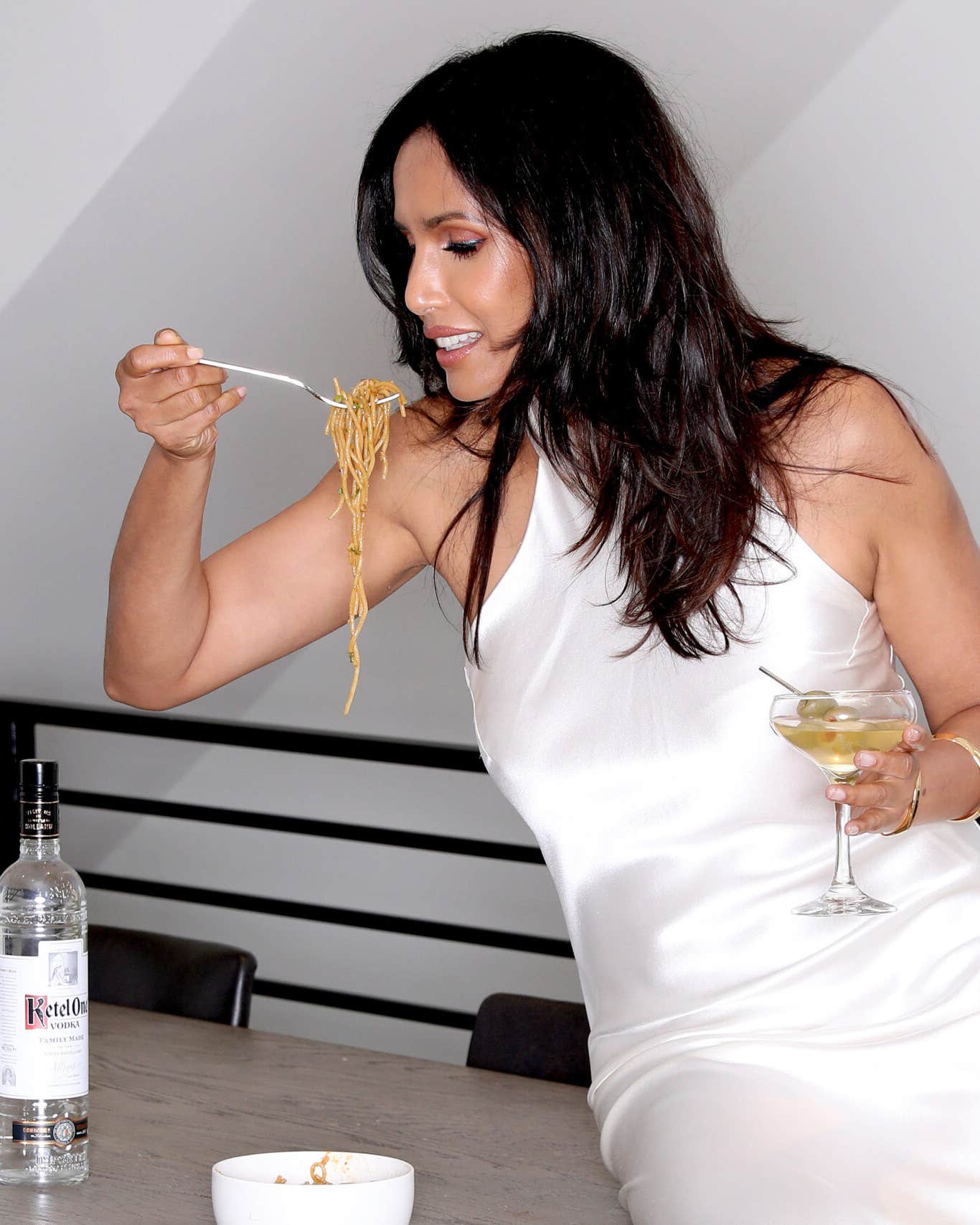
When we first moved to this country and I wanted spaghetti, my mom would make it for me. But everything she cooked, no matter what it was, would still taste Indian because she couldn’t help but add some cumin seeds and a little bit of chile and ginger. So when we had spaghetti, she would call it spaghetti upma, inspired by the South Indian dish made with semolina. She would sauté bell peppers, tomatoes, onions, garlic, ginger, and cut green beans, then break up the spaghetti, put it into a wok, add water, and leave the pan uncovered. The spaghetti would cook as the water evaporated, and somehow she always got the timing perfect.
When you’re playing dinner party DJ, what’s spinning?
It depends on the mood. I think when you’re creating a playlist, it’s important to start slow and have music that is good for the background but still allows people to talk. But generally, I love D’Angelo, Angie Stone, Alice Coltrane, SZA, and Lauryn Hill. I sometimes put on one of their radio stations, but I don’t play around during the party—I just set the music and don’t pay much attention after.
What is your biggest entertaining flex to impress guests?
I love Trudon candles. They’re the oldest candlemaker in France. In springtime, I like to get big branches and splurge on flowers. I have two or three dealers in the flower market who I tell exactly when the party is so that the flowers will be at peak bloom. I have also been collecting silver for a long time. Every year for my daughter’s birthday, I buy her a couple of serving spoons. One year, I found a pair of spoons from the 1800s that even had her initial monogrammed on them. We don’t use them for everyday meals, but for dinner parties, I tend to bust them out.
Tell me about a meal so good you would hop on a flight to relive it.
I once did this food fantasy tour that included a stop at El Bulli. There was a balloon that was made of a really thin layer of Gorgonzola, and it was kind of spectacular because I don’t normally like blue cheese. That beguiled me, and I remember it well.
This interview has been edited and condensed for clarity.
Keep Reading



Continue to Next Story
